Research Projects
Explore our lab's cutting-edge research in mood disorders and suicide prevention.
Neurocomputational Mechanisms of Depression and Suicide Risk under Naturalistic Conditions
Traditional neuroimaging research has largely relied on simplified and decontextualized experimental paradigms, limiting its ability to capture the dynamic psychological processes underlying depression and suicide risk in real-life settings. This research program adopts naturalistic paradigms, including real-world social interactions, emotionally evocative videos, and complex environmental inputs, combined with computational neuroscience approaches to systematically investigate how the brain encodes and processes emotional, threat-related, and self-referential information in ecologically valid contexts.
Key research foci include:
Differences in neural representations and computational processing characteristics under naturalistic conditions among individuals with depression and elevated suicide risk
Neural encoding patterns of emotional valence, social cues, and suicide-related content
individualized biases in neural representations and their correspondence with levels of suicide risk
This program aims to bridge the gap between laboratory-based tasks and real-world psychological experience, move beyond traditional group-level comparison paradigms, and develop individualized, interpretable neurocomputational models to provide a neural basis for understanding depression and suicide risk in real-life contexts.
National Natural Science Foundation of China (Young Scientists Fund)

Cross-System Dynamic Regulation of Suicide Risk: Heart–Brain–Gut Mechanisms
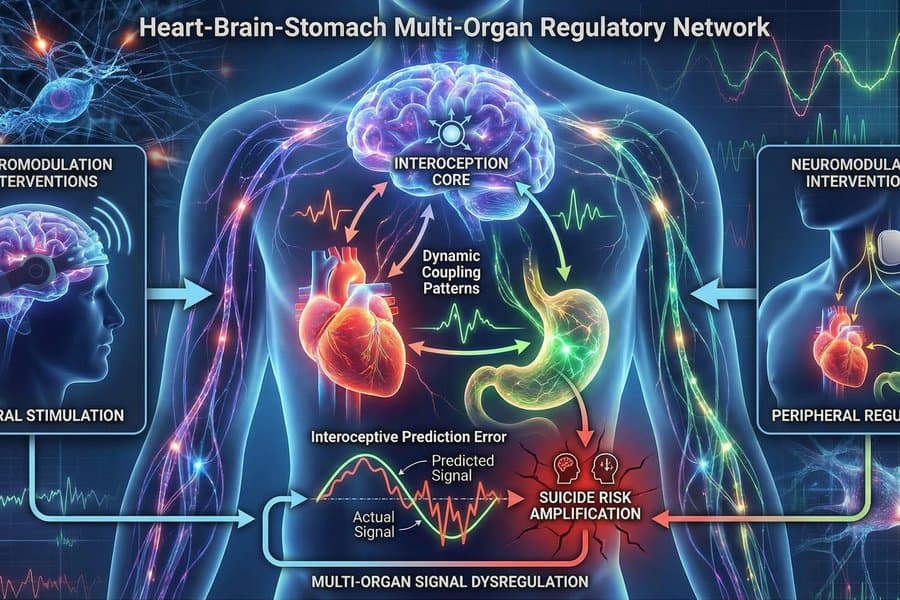
Depression and suicidal behavior are not solely driven by emotional or cognitive abnormalities within the brain, but are embedded within multi-organ regulatory networks involving the heart, gut, and brain. Grounded in the theoretical framework of interoception, this research program systematically investigates heart–brain–gut coupling and its cross-level role in the emergence and escalation of suicide risk.
Key research foci include:
Dynamic coupling patterns among cardiac autonomic signals, gastrointestinal interoceptive signals, and brain networks involved in emotion regulation and decision-making
The role of interoceptive awareness and interoceptive prediction error in suicidal impulsivity and loss of behavioral control
How multi-organ dysregulation amplifies suicide risk through impaired emotion regulation, reduced impulse control, and biased threat perception
Building on mechanistic findings, the lab further explores multi-organ–targeted neuromodulation strategies, including non-invasive central nervous system stimulation and peripheral neuromodulation approaches, to evaluate their effects on interoceptive processing, emotional stability, and suicide risk. This work aims to facilitate translation from mechanistic understanding to actionable intervention pathways.
National Natural Science Foundation of China (General Program);
National Natural Science Foundation of China – Young Student Basic Research Program (PhD Track).
Multimodal Dynamic Phenotypes of Suicide Risk in Depression and Bipolar Disorder
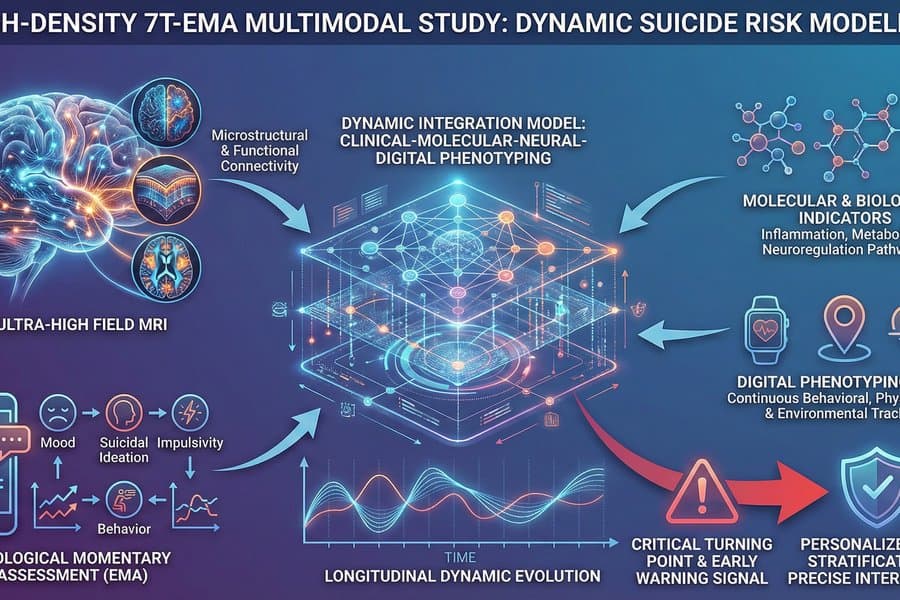
The lab is developing a high-density, longitudinal, multimodal research initiative, the Dense 7T–Ecological Momentary Assessment (EMA) Project, to systematically characterize the dynamic evolution of suicide risk in individuals with depression and bipolar disorder. This project emphasizes a research framework integrating ultra-high-resolution neuroimaging × high-frequency behavioral sampling × high ecological validity × cross-level integration.
Core components include:
7T ultra-high-field MRI: Fine-grained mapping of neural circuits, cortical laminar architecture, and functional connectivity related to emotion regulation and suicidal impulsivity
Ecological Momentary Assessment (EMA): High-frequency, real-world sampling of mood states, suicidal ideation, impulsive experiences, and behavioral changes
Molecular and biological measures: Focus on inflammatory, metabolic, and neuromodulatory pathways
Digital phenotyping: Continuous tracking of behavioral, physiological, and environmental data
Through longitudinal integration across multiple temporal scales, this project aims to construct dynamic clinical–molecular–neural–digital phenotyping models, identify critical transition points and early warning signals of suicide risk, and provide a scientific foundation for individualized risk stratification and precision intervention.
National Natural Science Foundation of China (Young Scientists Fund);
Beijing Natural Science Foundation.
Behavior–Neural Coupling of Speech, Language, and Brain Signals in Depression and Suicide Risk
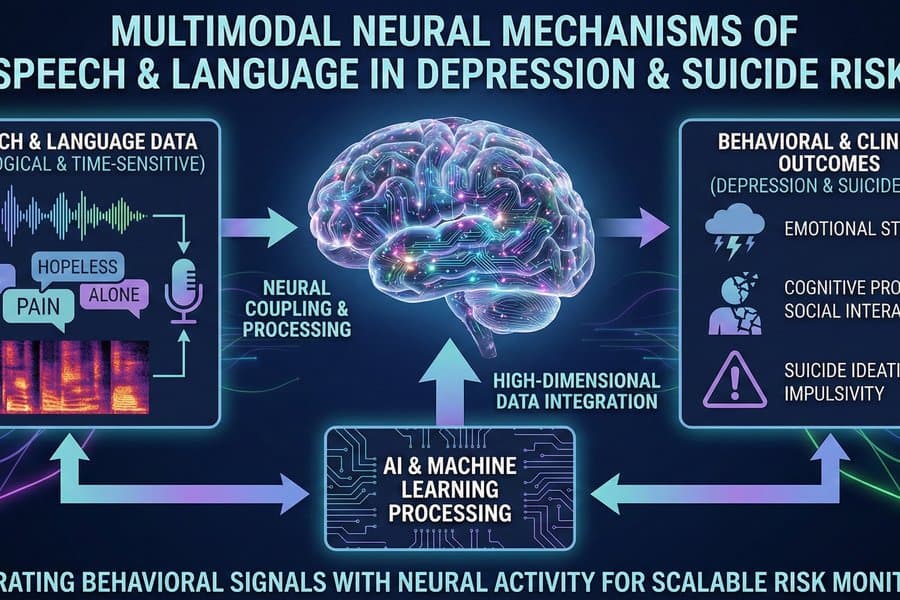
Speech and language represent some of the most ecologically valid and time-sensitive behavioral markers of depression and suicide risk, dynamically reflecting emotional state, cognitive processing, and social interaction patterns in natural communication contexts. This research program focuses on the coupling between speech and language features and neural signals to elucidate the neurobiological mechanisms underlying suicide-related behavioral expression.
Key research foci include:
Systematic characterization of speech features, linguistic content, and expressive patterns associated with depression and suicide risk
Neural correlates of speech and language changes at the level of brain networks and circuits
Coupling patterns between behavioral signals and neural activity across psychological states such as low mood, heightened suicidal ideation, and increased impulsivity
Artificial intelligence and computational techniques are employed as analytical and modeling tools to process high-dimensional speech, language, and neural data. Through multimodal integration, this program aims to advance understanding of the neural foundations of suicide-related behavioral phenotypes and support scalable approaches to risk monitoring and clinical assessment.
Beijing Natural Science Foundation;
Joint Research Fund between the Vanke School of Public Health, Tsinghua University, and the Saw Swee Hock School of Public Health, National University of Singapore.